Start with the decision, then choose the order size
For an AV integrator, distributor or project buyer, the useful question is what evidence is still missing before committing to the deployment. One sample can help evaluate a single unit; it does not automatically validate a joined display, every unit in a batch or the conditions at a different venue.
Use the matrix below as a purchasing recommendation. Sample availability, minimum order quantity, pricing and the evaluation schedule must be agreed in the quotation.
| Your purchasing situation | Suggested route | Evidence needed before the next step |
|---|---|---|
| First project with an untested configuration | Sample or evaluation order | Accept representative content, operating workflow and installation fit against a written checklist. |
| Repeat order with an accepted, unchanged configuration | Consider a bulk order | Confirm the configuration revision, current supply scope, batch checks and destination requirements. |
| Pixel pitch, controller or cabinet has changed | Revalidate the affected functions | Record the change and repeat the checks it can influence; do not rely only on the previous sample. |
| Several posters will form one joined canvas | Validate the intended joined system | Check the controller load, content map, alignment, synchronisation and cable route for the planned layout. |
| Rain exposure, direct sunlight or uncertain site conditions | Resolve suitability before ordering | Obtain approval for the complete installed configuration; a front IP rating alone is insufficient. |
| A fixed event date leaves little evaluation time | Agree an achievable validation and delivery plan | Include evaluation, issue resolution, production, freight and commissioning; request a revised plan if these cannot fit. |
Specify what the sample must represent
Ask for an evaluation unit that represents the configuration you intend to purchase. Record the model, pixel pitch, controller and software, cabinet and base, power arrangement, connection locations and any selected accessories. Document substitutions before accepting the unit.
For the KEDA HB-X mobile LED poster series, the active display is 640 × 1920 mm and the cabinet is 646 × 2050 mm. The original brochure lists a net weight of 43 kg. Use these product values to check access and placement; packed dimensions and gross weight require a separate packing specification.
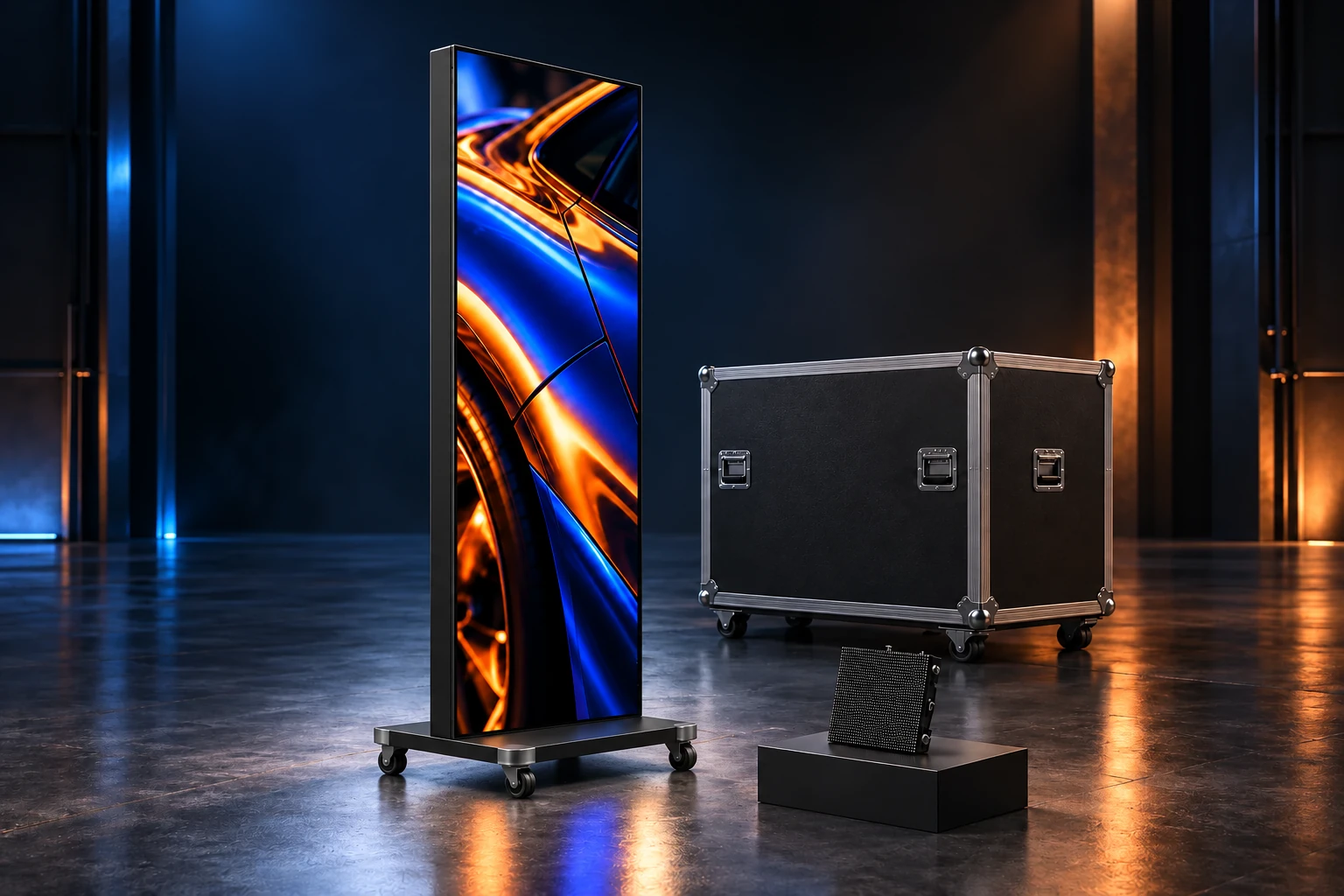
This guide concerns HB-X purchasing decisions. LCD signage, folding LED products and other cabinet formats need their own configuration and acceptance criteria. The studio image above is a generated illustration, not evidence of a tested unit or a confirmed packing arrangement.
Turn the sample into a recorded acceptance decision
Agree pass criteria before evaluation and keep the results with the configuration record. Use your actual content and intended operating conditions wherever practical. A showroom demonstration or an attractive rendering cannot replace that record.
- Display: review representative video, small text, gradients and dark content from the intended viewing position; agree acceptable results with the supplier.
- Workflow: test the agreed upload, playback and update method, including the permissions and network access your team will actually have.
- Restart: check the documented recovery behaviour after an agreed normal power-down and restart; record any manual steps.
- Installation: confirm access, stability, wheel locking, cable routing and service access with the installer. Keep power and data connections away from the audience side.
- Camera use: if the display will be filmed, test the planned camera settings and content. A refresh-rate specification alone does not prove a banding-free or moiré-free result.
- Handover: retain the settings, configuration revision, photos and an issue list with an agreed closure or acceptance decision.
One accepted sample does not validate a joined display
If the purchase depends on multiple HB-X posters operating as one canvas, ask how the supplier will demonstrate the intended system. Test the content map and controller capacity for the selected pitch and screen count, together with alignment, playback synchronisation and the proposed connection route.
Six HB-X active displays placed side by side form a nominal 3840 × 1920 mm canvas with a 2:1 aspect ratio. Prepare content for that shape. Do not assume it is 16:9, or that a controller demonstrated on one unit can drive all six in the planned arrangement.
For non-folding HB-X posters, the intended audience-facing display is continuous. The joined installation should not introduce intentional black gaps, exposed front-facing connectors or a second visible display layer. Confirm the physical assembly details with the engineering team.
Release the bulk order against a frozen configuration
A successful sample is a reference for the next order, not a substitute for batch inspection. Before releasing a bulk order, identify the accepted configuration and agree how the delivered units will be checked against it. Any proposed substitution should trigger a review of the functions it can affect.
- Attach the accepted model, configuration revision, controller and selected options to the order specification.
- Close evaluation issues or record explicit exceptions and the action required before shipment.
- Agree batch inspection coverage, acceptance criteria and the records you will receive; do not assume an unspecified sampling plan.
- Confirm packing, spare parts, documentation, destination and the planned installation workflow.
- Check the agreed warranty scope and support procedure. KEDA publishes a two-year warranty; refer to the warranty policy and the order terms for coverage and exclusions.
Compare the complete order scope, not only unit price
Request separate sample and bulk quotations on a comparable basis: display configuration, controller, accessories, spare parts, packing, freight scope and destination. Record evaluation costs, any second shipment and commissioning needs in your own project budget. Do not assume a sample fee will be refunded or that a larger quantity automatically qualifies for a particular discount.
Specify the agreed Incoterms® rule, named place and version when comparing delivery offers. ICC explains that these rules allocate delivery tasks, costs and risks between seller and buyer. Ask which charges are included and who handles the remaining transport, insurance or customs steps; the display price alone does not answer those questions.
Ask for a written schedule covering evaluation, any corrections, production, transport and site commissioning. This guide does not set a universal sample price, minimum order, freight cost or lead time.
What a sample cannot prove
A short evaluation does not establish lifetime, certification compliance or suitability for every climate. Request the documents applicable to the exact configuration and destination, and involve the responsible installer or compliance adviser where required.
For HB-X, the published IP54 protection applies to the front only. It does not establish weather protection for the rear, base, power or data connections, or the complete installed system. The published 1000 nits brightness also does not establish suitability for every sunlit location. Resolve the site requirements before placing an outdoor-use order.
Quick answers before you request a quotation
Is a sample always necessary? No. An unchanged repeat configuration with accepted performance and an agreed inspection plan may support a bulk purchase. A first order or a material change leaves more to validate.
Is one sample enough for a multi-screen project? It can evaluate the single unit, but it does not prove the intended joined canvas. Agree a system demonstration or validation plan for the actual layout.
Can a deadline justify skipping validation? It changes the planning constraint, not the evidence required. Ask what can realistically be checked and delivered before committing to a schedule.
What should the first inquiry include? Send the application, sample and rollout quantities, destination, viewing conditions, content examples, planned screen arrangement and required date. State what must be demonstrated before you can approve a bulk order.
Product documents & next steps
Use the current product documents alongside this guide. Confirm the final specifications, available options and commercial terms for your selected configuration.
- HB-X engineering requirements and multi-screen planning
- GOB, IP54 front protection and installation conditions
- HB-X delivery and acceptance checklist
- KEDA two-year warranty and support policy
- ICC: purpose and scope of Incoterms® rules
- Compare LED poster formats
- Review the HB-X1.86 LED poster specifications