Start with how the display will be used
Both options are direct-view LED displays. The main decision is how the screen fits the space and how your team will deploy it. A fixed installation can be freestanding on an engineered structure; it does not have to attach to a building wall.
Use this matrix to shortlist a format, then validate the selected model and site. These are project recommendations, not guarantees that every poster or fixed-display series supports the same features.
| Project requirement | Format to shortlist | What to verify |
|---|---|---|
| A portrait promotion moves between showroom positions | Mobile LED poster | Movement route, floor footprint, power access and representative content. |
| A permanent feature must fill a defined architectural opening | Fixed LED display | Cabinet grid, finished dimensions, mounting structure and service access. |
| An event team reuses the same joined layout | Joined LED posters | Active canvas, controller capacity, alignment, connections and transport scope. |
| A long, tall or unusual permanent canvas is required | Fixed or custom LED system | An approved layout and structure that achieve the required geometry. |
| The display will face rain or direct sunlight | A configuration approved for that environment | Brightness, complete installed protection and destination-specific documentation. |
| Several stores need a repeatable setup | Evaluate posters and fixed displays against a pilot site | Site variation, content operation, handling and the complete rollout cost. |
When is a mobile LED poster the better fit?
A mobile poster is worth evaluating when display positions or campaign layouts change and a portrait canvas suits the content. The HB-X series has a 640 × 1920 mm active display area, a listed 646 × 2050 mm overall width and height, and a four-swivel-wheel base.
The published HB-X weight is 43 kg per unit. A slim appearance and wheels do not make it a hand-carried screen. Check doorways, thresholds, floor conditions, storage and the approved handling method; obtain the complete base-footprint drawing before planning an aisle.
For a distributor or retail team, test the ordinary tasks: moving to the approved position, connecting power, publishing a campaign and returning the unit to storage. Confirm whether the quotation covers the upright configuration or a separately specified folding option.
When should you choose a fixed LED wall?
A fixed LED wall is worth shortlisting when the display will stay in one location and its dimensions should follow the architecture or content brief. Plan the cabinet grid, supporting structure, cable paths and maintenance access together rather than treating the screen face as the complete installation.
An indoor reception feature and an outdoor advertising wall are different specifications. Start with the appropriate fixed-display series and request its selected pixel pitch, finished size, power requirements, brightness and environmental documentation. Do not transfer HB-X specifications to a different product family.
Front access can change the service plan, but the selected cabinet and mounting structure must support it. Ask the installer to confirm how modules, power supplies and other serviceable parts can actually be reached after installation.
Can joined LED posters replace a fixed LED wall?
Joined posters can suit a reusable presentation canvas when their geometry and floor arrangement match the brief. They still require a coordinated controller, content map, power plan and approved connection layout. Joining units does not automatically make the complete system suitable for a permanent architectural installation.
For HB-X units, calculate the active canvas from 640 mm width × 1920 mm height per poster. Three units form 1920 × 1920 mm, or 1:1. Six form 3840 × 1920 mm, or 2:1. Six units therefore do not form a 16:9 canvas. These figures exclude the surrounding hardware and base footprint.
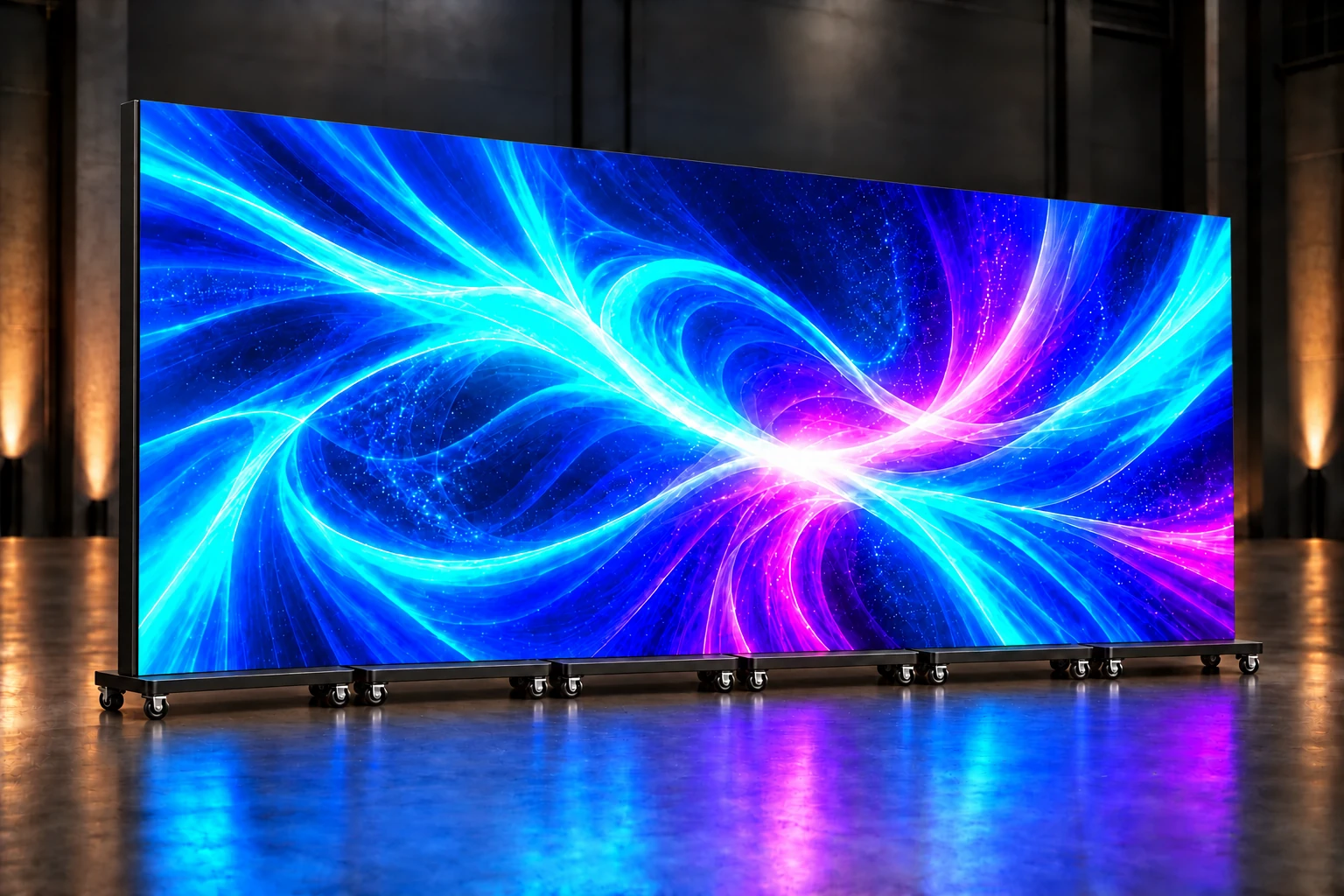
Define the content at the final pixel resolution for the chosen pitch and unit count. Test cropping, typography, synchronization and the inward or rear connection route before approval. The hero image is a generated product visualization of a joined layout, not a photograph of a delivered installation.
- Confirm the exact number of units and their active display dimensions.
- Approve a native pixel map and test your own media on the joined canvas.
- Confirm controller capacity, synchronization and the power and data route.
- Review total floor footprint, access and the dismantling or storage plan.
Which site and image checks can change the decision?
Evaluate viewing distance, the smallest important text, ambient light and the content itself on both shortlisted options. Pixel pitch and final resolution influence the result; a larger screen or a smaller pitch is not automatically the best answer to every brief.
The HB-X specification lists 1000 nits and IP54 front protection. That front rating does not establish protection for the rear, connectors or the whole installation, and the brightness figure does not guarantee direct-sunlight readability. Approve outdoor suitability for the complete selected configuration before choosing a format.
For both options, identify who updates content, whether live sources are needed, and how the display should recover after a power interruption. Request the named controller and software workflow rather than assuming all LED systems operate in the same way.
Which option has the lower total project cost?
There is no reliable universal price winner. Compare written quotations for the same acceptance criteria and operating period. A mobile screen may reduce some permanent-installation work while adding handling, storage and repeat deployment costs. A fixed system may need more site work while avoiding repeated relocation.
A useful comparison is: total project cost = display and control equipment + installation and site work + packing and logistics + operation and service over the chosen period. Include any removal or redeployment cost that matters to your project.
For energy planning, use agreed representative average input power in kW × operating hours × the local electricity tariff. Confirm the measurement conditions; do not treat a peak-power specification as normal consumption or compare quotations covering different display areas without stating that difference.
| Cost group | Mobile or joined posters | Fixed LED wall |
|---|---|---|
| Equipment and control | Units, bases, controller, joining accessories and agreed spares | Cabinets, controller, mounting system and agreed spares |
| Site and installation | Placement, power points, cable routing and joined-layout setup | Site survey, support structure, power distribution and installation |
| Logistics and handling | Transport cases, packed weight, movement and storage | Protective packing, freight, site handling and installation access |
| Operation and service | Energy, publishing workflow, redeployment and repairs | Energy, publishing workflow, maintenance access and repairs |
How do three common project briefs lead to different choices?
These examples illustrate the decision process; they are not customer case studies. The recommendation changes when the site conditions or acceptance requirements change.
- Showroom with rotating portrait campaigns: shortlist an HB-X poster, then check the travel route, floor footprint and actual campaign content.
- Permanent wide reception feature: shortlist an indoor fixed LED wall and develop its finished dimensions, mounting and service plan with the installer.
- Repeat exhibition booth with a wide presentation: evaluate joined posters if the active ratio and floor layout fit; compare a modular rental-display system when the brief requires a different structure or layout. A rental-display cabinet is a product format, not a promise of a hire service.
Quick answers before you request a quotation
Is a mobile LED poster always cheaper? No. The result depends on the display area, configuration, installation, repeated handling and operating period. Compare the complete scope rather than unit price alone.
Does joining six HB-X posters create 16:9? No. Their published active dimensions produce 3840 × 1920 mm, which is 2:1. Confirm how a 16:9 video will be adapted for that canvas.
Does a fixed wall always offer a better image? No. Evaluate the selected pixel pitch, resolution, calibration, viewing conditions and sample content for both systems.
What should I send for a recommendation? Send the available width and height, intended content ratio, viewing positions, site photos, lighting and environment, relocation frequency, quantity and destination. Add installation, controller, packing and acceptance requirements so both alternatives can be quoted against the same brief.
Product documents & next steps
Use the current product documents alongside this guide. Confirm the final specifications, available options and commercial terms for your selected configuration.
- HB-X1.86: current published specifications and configuration notes
- Fashion Indoor LED Display: fixed-installation series and service requirements
- Engineering guide: joined canvas, control and installation planning
- GOB and IP54 front protection: placement decision guide
- Compare the fixed LED display collection
- LED poster quotation checklist
- Compare LED poster formats