Which screen arrangement fits your location?
Start with the display position and actual approach directions, then choose the product format. Double-sided signage has two outward-facing display surfaces. A folding rear support, a service cover or a group of screens joined into one wider canvas does not, by itself, make a display double-sided.
Use this matrix to shortlist a layout. The recommendations are planning guidance, not a claim that a particular product is approved for every position.
| Your location or content brief | Arrangement to shortlist | Check before selecting |
|---|---|---|
| Display against a wall, with customers approaching from the front | Single-sided | Viewing angle, content readability and service access. |
| Open indoor circulation area with two opposing approaches | Double-sided | Useful sightlines to both faces, complete footprint and clear pedestrian routes. |
| Inside a shop window, addressing the street and the store interior | Indoor double-sided window format | Glass reflections, sunlight, thermal conditions and content for each audience. |
| One wide presentation for a showroom or exhibition audience | A single-facing LED canvas or joined LED posters | Active dimensions, final pixel map, controller and floor or mounting arrangement. |
| Two audiences need different screen positions or viewing heights | Compare a dual-face unit with two separately placed displays | Sightlines, support, power, content management and total installed scope. |
| An exposed exterior position | First select a configuration approved for the site | Enclosure and connector protection, operating limits, stability and charging conditions. |
Will the second face serve a real audience?
Mark the proposed cabinet footprint on the site plan. Walk each approach at normal customer eye level and identify where the message first becomes visible. Check furniture, door swings, queues, shop glazing and other obstructions. A second screen facing a wall or a restricted service area may add equipment without solving a customer need.
Decide what each audience needs to do. An outward-facing shop-window campaign might need a simple product image, while the inward-facing screen might carry product information. Two opposing routes in a mall might use the same campaign, but the reading distance and dwell time can still differ.
These are layout examples, not delivered customer cases. For a wall-backed showroom promotion, shortlist a single-facing poster. For an open indoor promotional island, evaluate a back-to-back format. For a shop window, keep the unit indoors and evaluate the through-glass viewing conditions separately from the interior face.
- Photograph both approaches from the positions customers will actually use.
- Mark the full base, operating clearance and service zone, not just the screen face.
- Assign an audience, message and content orientation to each useful face.
- Compare another cabinet position or two separate displays if the sightlines do not work.
Does double-sided mean LCD, and does single-sided mean LED?
No. Display technology and the number of outward-facing screens are separate specification choices. Compare the exact products being quoted; a technology label does not establish face count, playback independence or a mounting arrangement.
The upright KEDA HB-X views show a continuous, single-sided LED poster. Its published active display area is 640 × 1920 mm. Joining HB-X posters side by side widens the audience-facing canvas; it does not add a rear screen. Six active areas form 3840 × 1920 mm, or 2:1, rather than 16:9.
The 43-inch Indoor Double-sided Battery Display is a different LCD product format, listing back-to-back screens and an integrated mobile pedestal. The 43-inch Rotating Double-sided Window Display is an indoor window format, with its orientation assembly and independent content hardware to confirm. Do not transfer HB-X power, protection or control specifications to either LCD model.
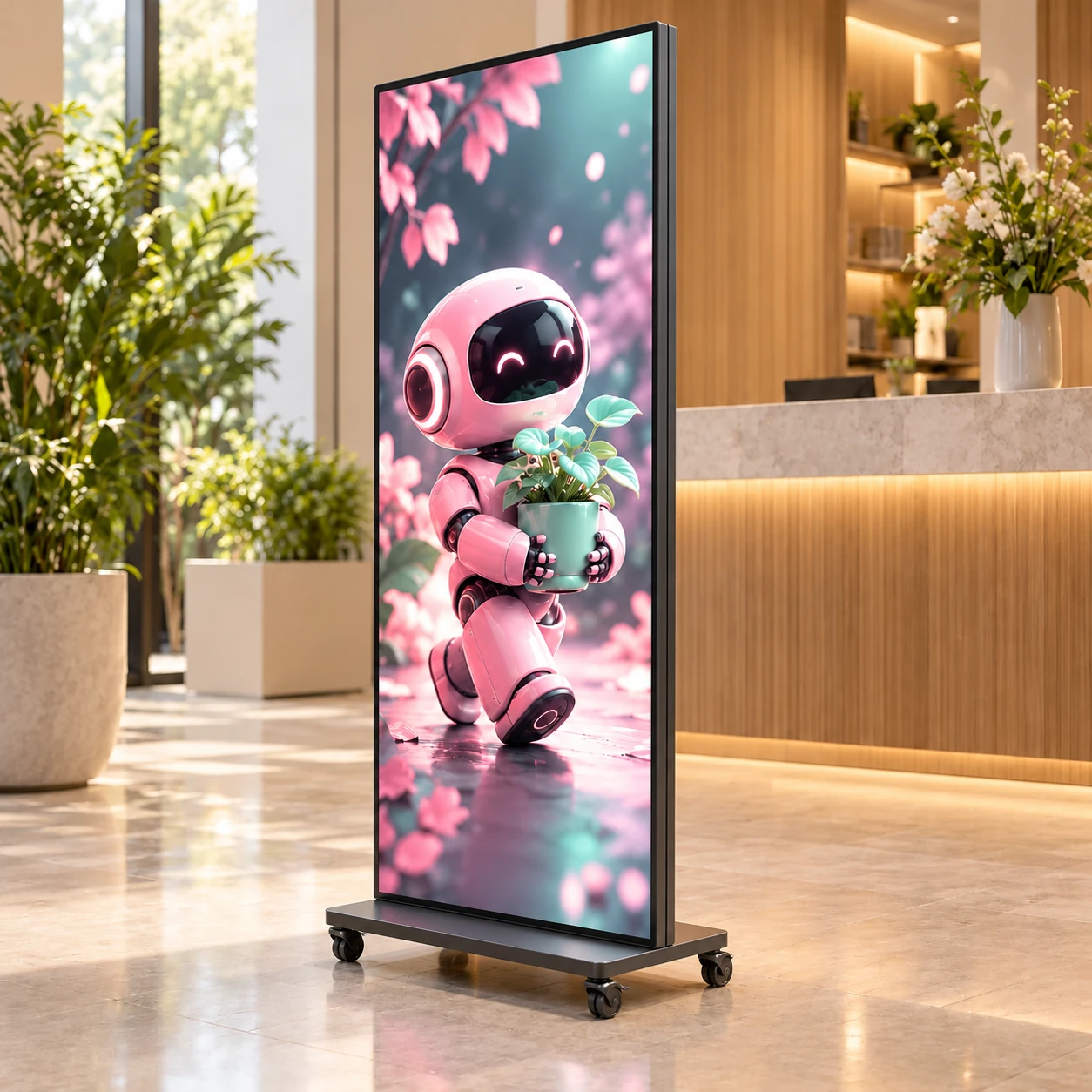
The hero image is a generated concept for the indoor dual-face LCD family, not a delivered installation photograph or a dimensioned construction drawing. Use the selected model drawing to confirm the actual screen arrangement, cabinet and support.
Review the single-sided HB-X1.86 LED poster
Do two faces include independent playback?
Not automatically. Mirrored playback repeats the same content on both faces; independent playback allows the faces to show different content. Confirm the required player outputs, screen mapping, software licences and scheduling functions in the quotation. Two physical panels alone do not establish those capabilities.
Give the supplier a test brief: the required playlist for each face, portrait or landscape orientation, update method, operating schedule and behavior after a normal power-down and restart. If audio is needed, specify how it should operate when the two playlists differ.
For multi-store operation, also identify who can publish to each face, whether updates must work across the available network, and what should play if connectivity is interrupted. Ask for a demonstration of the agreed workflow rather than relying on the phrase “cloud control”.
How do footprint, movement and servicing affect the choice?
Compare the complete assembly: panel orientation, cabinet depth, base projection, height, total weight, cable exits and any rotation or opening path. A slim screen surface does not define the floor footprint, and wheels do not establish that a loaded unit can be moved safely through every route.
The HB-X brochure lists a 43 kg display weight. Use that value only for the HB-X series; the complete weight and handling requirements of a dual-face LCD cabinet need their own confirmation. Packed dimensions and shipment gross weight are separate from either display’s net weight.
Check how serviceable parts can be reached in the final position. A back-to-back cabinet may need clearance for a service cover or an approved opening mechanism. An A-frame can have one front screen and a folding rear support. Motorized opening, motorized tilt and manual support folding are different mechanisms; request the selected drawing and operating instructions.
What changes for battery power, heat and outdoor placement?
Request total-system power and battery runtime with the agreed number of faces operating, brightness, content, connectivity and daily schedule. A demonstration with one panel active does not validate a two-panel operating routine. Do not assume runtime is unchanged, or that energy use will be exactly twice that of an unrelated single-sided model.
Agree the battery capacity, charging arrangement, reserve requirement and protected storage position for the selected configuration. Two faces can also have different thermal conditions, especially behind shop glass. Specify ambient conditions, ventilation clearance and cooling maintenance with both screens operating.
An indoor display looking through a window remains an indoor installation. The HB-X series specifies 1000 nits and IP54 front protection; those values do not make its rear, connectors or complete installation weatherproof. For an outdoor LCD or LED project, obtain approval for the selected enclosure, connectors, operating limits and stability at the actual position before deciding on face count.
Which arrangement gives better value in the quotation?
There is no universal cost winner. Compare offers against the same audience requirement and operating period. A second face can be useful when it replaces a genuinely needed second position, but two screens do not guarantee twice the reach, more enquiries or a particular payback.
Request a like-for-like scope and identify anything that remains optional. Include installation, content operation, transport, storage and service in your own project budget rather than comparing cabinet prices alone.
| Quotation item | Single-sided scope | Double-sided scope |
|---|---|---|
| Display configuration | Selected panel or LED pitch, active canvas and agreed image requirements | Selected panel and requirements for each face; do not assume identical exposure conditions |
| Content operation | Player, media formats, upload method and licences | Mirrored or independent outputs, per-face mapping, schedules and licences |
| Support and access | Base or mounting drawing, complete weight and service route | Complete cabinet and base, clearance on both sides and any approved opening or rotation path |
| Power and environment | Whole-unit power and any selected battery test conditions | Whole-unit power, runtime and cooling with both faces operating |
| Delivery and after-sales | Protective packing, gross weight, documents and support scope | Packing for the complete assembly, agreed spares and selected-configuration service scope |
Quick answers before choosing the number of faces
Is double-sided signage always the better choice? No. Use it when two useful viewing directions justify the cabinet, footprint and operating scope. A single-facing display can be the better fit against a wall or for one defined audience approach.
Can each side show different content? Only when the selected player, outputs, software and licences support the required independent workflow. Record it explicitly and test both faces before acceptance.
Is a folding A-frame automatically double-sided? No. The rear can be a support or service surface. Confirm the number and direction of actual display faces from the selected specification and drawing.
What should I send for a recommendation? Send site photos from both approaches, available floor space, the intended message for each audience, orientation, operating hours, mains or battery needs, quantity and destination. Add any window, outdoor, movement or service constraints so the factory can compare appropriate configurations.
Product documents & next steps
Use the current product documents alongside this guide. Confirm the final specifications, available options and commercial terms for your selected configuration.
- HB-X1.86: current single-sided LED poster specifications and model FAQ
- 43-inch indoor double-sided LCD: layout, battery and playback checks
- 43-inch rotating window display: indoor placement and separate content requirements
- 43-inch folding LCD: single-sided screen with a folding rear support
- 55-inch outdoor dual-face LCD: enclosure, thermal and battery scope to confirm
- GOB and IP54 front protection: placement limitations
- Compare LED poster formats
- Compare portable LCD displays for indoor use